
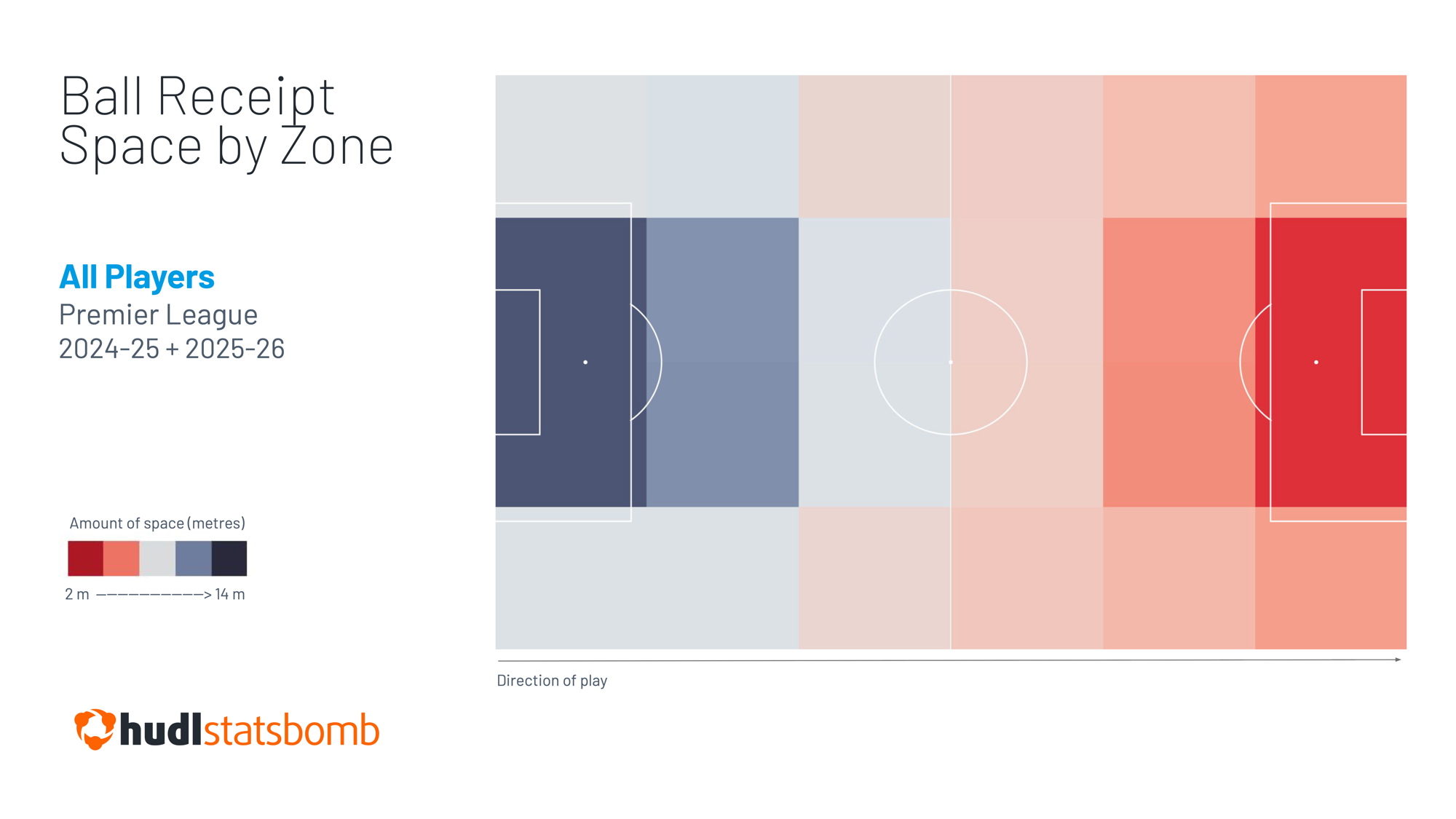
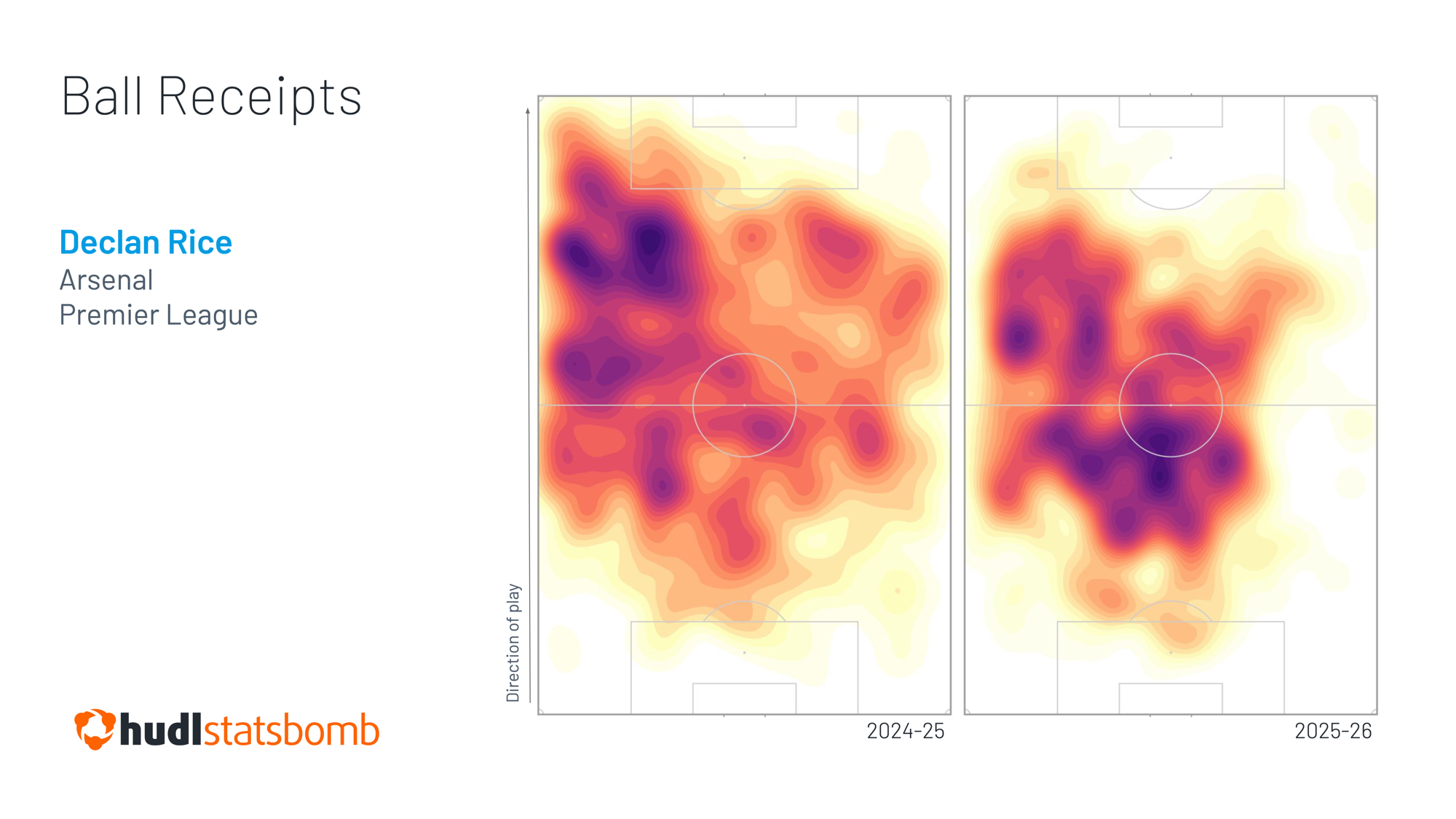
And if we map Rice’s ball receipts from this season versus last, it is immediately apparent that he is more often receiving the ball in those higher-space areas. Indeed, if we focus on just the central corridor of his own half, the percentage of his total ball receipts that occur in that zone has increased from 24% last season to 39% this time around.
That has undoubtedly contributed to an increase in the amount of space in which he receives the ball. On average, Rice has had 7.82 metres of space around him upon receipt – the most since his penultimate season at West Ham, and nearly a metre more than last season.
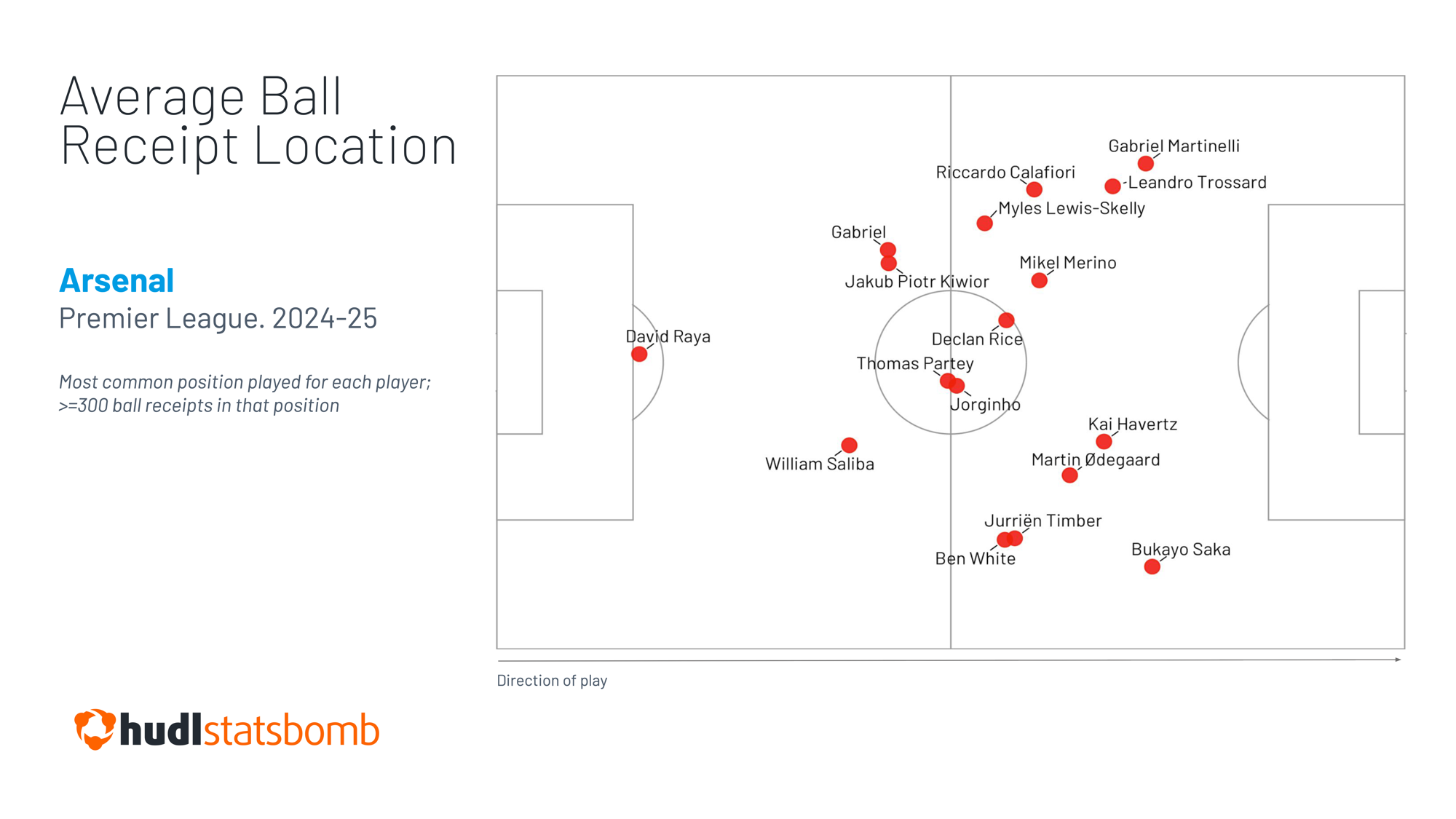
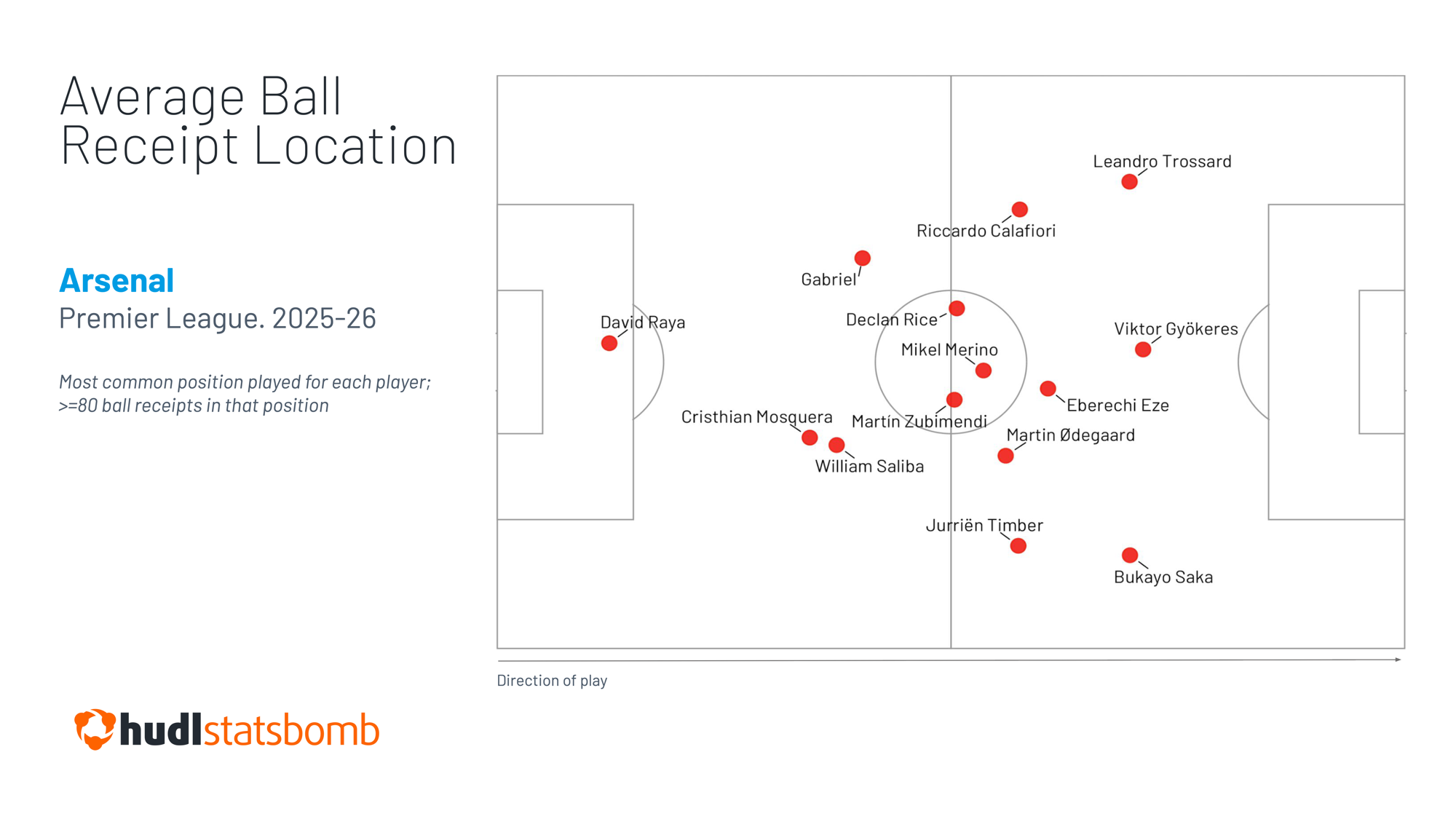
But the fuller explanation appears to be related to a wider shift in how Arsenal collectively occupy and utilise space.
If we take the average ball reception location of Arsenal’s players last season, filtering to the position each player occupied most frequently…
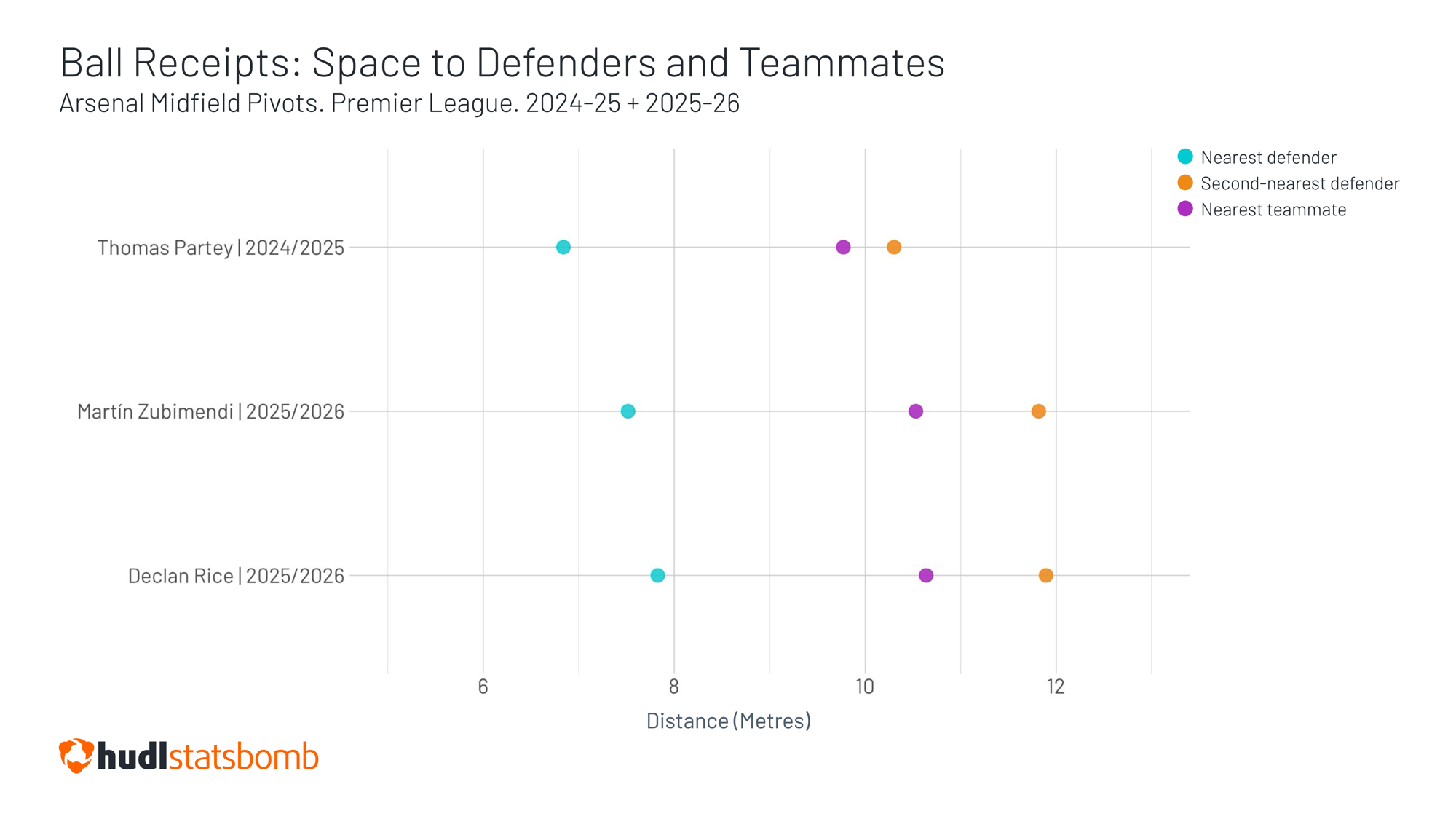
Not only do they have more immediate space, but on average, the second closest defender and their closest teammate are also further away than they were from Partey last season. Indeed, it is notable that even in the less-congested areas of the pitch, when Rice receives the ball this season he does so in more space than on the occasions he dropped into them last season.
In that increased space, Rice and Zubimendi have gained weight in the construction of play: 23% of the passes Arsenal have attempted per match this season have been from their feet versus 19% from those of Rice and Thomas Partey last season.
Progressive passes show a similar story: Rice and Zubimendi account for 27% of the team’s line-breaking passes this season versus the 22% contribution of Partey and Rice last time around.
As noted earlier, Rice’s personal contribution has increased to 5.31 line-breaking passes per 90 – a near 40% increase season-on-season.
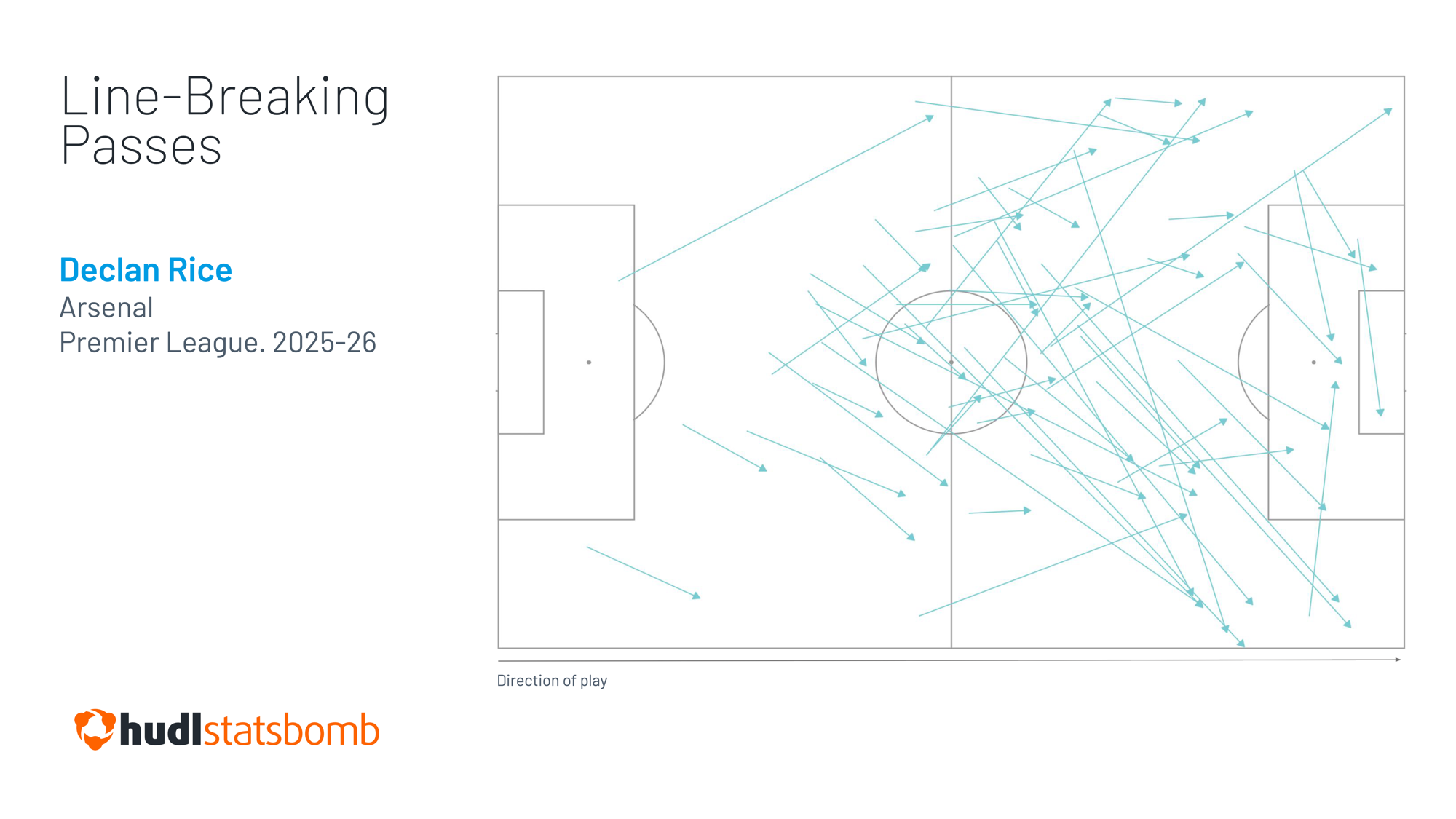
While the range of recipients is fairly similar, aside from a new preference towards Buyako Saka on the right rather than Leandro Trossard on the left and another we’ll get to shortly, there are a couple of notable differences. He is playing more of these passes from within his own half (44% vs. 38%), while the average length of his line-breaking passes has increased by three metres.
That latter one tallies with a wider change to his passing profile. Rice has played over one more long ball per 90 than in either of the previous two campaigns, contributing to his average pass length nudging up by a metre or so. But it is interesting to note that under pressure from an opponent, his pass length has remained consistent, further suggesting that the additional space he is enjoying has contributed to his more expansive passing range.
The other clear difference in who Rice’s line-breaking passes are aimed at involves Zubimendi, and highlights the strengthened midfield connection brought about by a more defined double pivot.
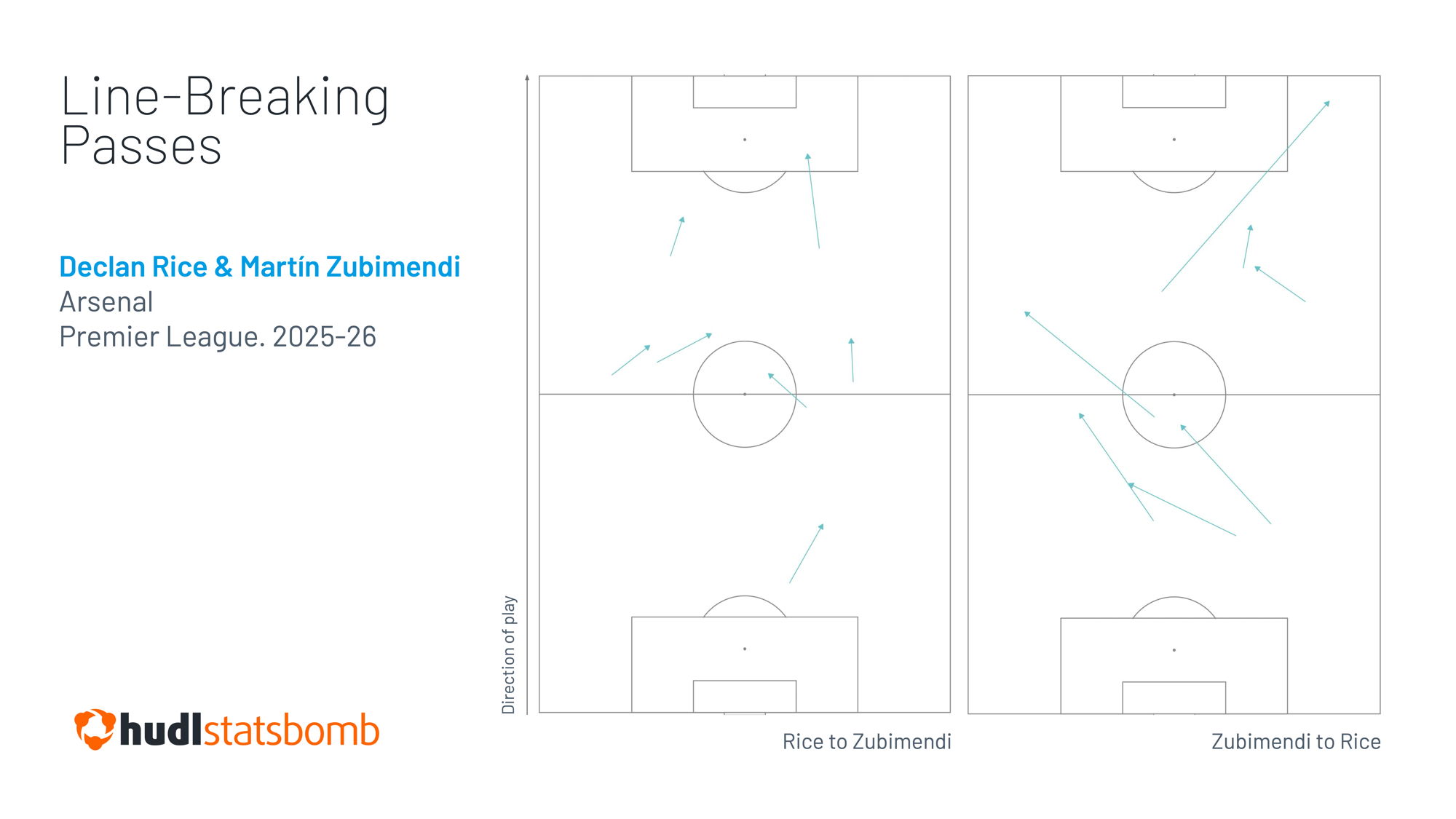
Rice and Zubimendi have already exchanged just five less line-breaking passes (14) than Rice and Partey did in the entirety of last season, and the split is also far more equitable. Last season, Rice was primarily a forward option for Partey’s passes, accounting for 17 of the 19 line-breaking passes they exchanged; this season, Rice and Zubimendi have shared seven apiece.
There is more intricate interplay at work, with the footage showing various neat little movements to create angles to advance the ball.
One of the primary narratives around Zubimendi’s arrival has been that it has released Rice to more freely join the Arsenal attack. It was likely precipitated by Rice’s goal-and-assist performances against West Ham and Burnley, but there is little in the data to suggest that is actually the case.
In fact, looking at the metrics we’d traditionally use to measure final-third presence – things such as shots, key passes, touches in the box, passes completed within 20 metres of goal and so on – the large majority are either steady or down season-on-season. While it isn’t out of the question that his contribution there is primarily off-ball, it isn’t the strongest thread to highlight from Rice’s impressive start to the season.
The real story is how the signings of Zubimendi and Gyökeres have changed the dynamics of how Arsenal use space and in doing so have given Rice the platform to become something he arguably hasn’t been since his days at West Ham: a primary engine of ball progression from deep.
Statsbomb 360, including ball receipts in space and line-breaking passes, is now available at no additional cost across all applicable leagues to Hudl Statsbomb customers, providing an additional layer of context that is also synced to video in our platform.
Get in touch today to find out more.